
This only 3-component circuit causes a small lamp to blink with the sound of your amplifier. The circuit can be used with amplifiers from 2 to 100 W without problems.
For science fairs and demonstrations, it will serve to show how sound can be converted into light in an energy transformation experience or to explain the working principle of neon transformers and light bulbs. An important detail of this circuit is that the energy it uses to operate comes from the amplifier itself and so it does not need to be connected to batteries or other power source.
OPERATION
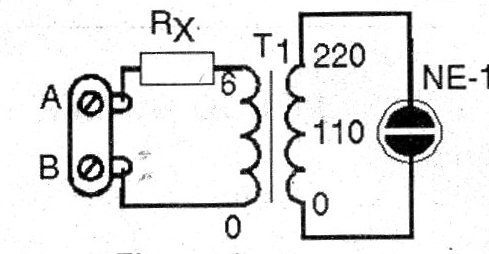
The current variations that correspond to the sound are applied to the low voltage winding of a small transformer. In this way the induction of high voltage occurs in its other winding and this voltage has the same variations of the sound that is being reproduced.
This voltage is sufficient to light a small neon bulb that needs at least 80 V for this. In this way the small lamp starts blinking in the same rhythm as the music that is played on the sound system.
ASSEMBLY
In figure 1 we have the complete diagram of the neon rhythmic micro light system.
In figure 2 we have the actual appearance of the assembly.
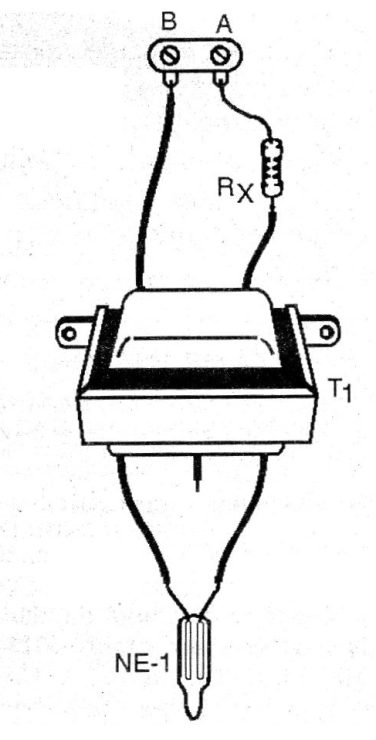
The transformer and the resistor can be installed inside a small plastic box. The value of the resistor depends on the power of the amplifier according to the following table:
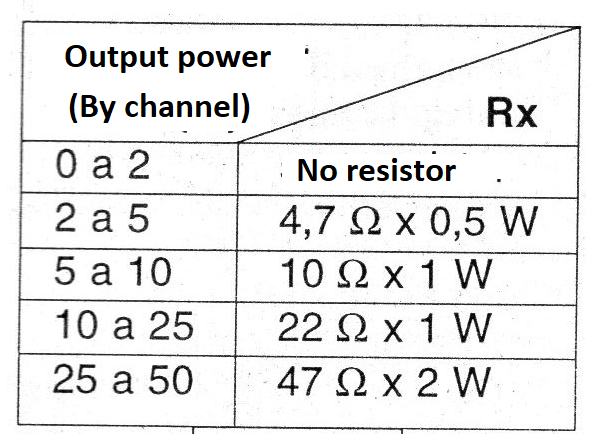
If your system is stereophonic, you can mount a rhythmic light like this for each channel.
The transformer is of any type used in primary 110 V or 220 V secondary winding power supplies with any voltage between 4 and 12 V and current between 50 mA and 300 mA. The neon lamp is common, NE-2H or equivalent.
TEST AND USE
The circuit is connected to the speakers or outputs of each channel of the amplifier. Adjust the volume of the amplifier so that the lamp blinks along with the sound being played.
WHAT TO EXPLAIN
Check how the transformer works and explain how it increases the output voltage of the amplifier so you can power a neon lamp that needs 80 V to light up. Explain why variations in brightness occur with sounds.
SUGGESTIONS
If you put two electrodes for a person to hold, and connect them to the point where the neon lamp is (the neon lamp must be removed) transmitting the sound sensation through the skin in the form of shocks. This feeling should be carefully controlled by the volume of the amplifier.
MATERIAL LIST
T1 - Transformer - see text
NE1 - common neon lamp
Rx - resistor - see text
Several:
Housing for mounting, antenna / ground bridge, wires, solder, etc.


