
This low-power experimental oscillator can generate audible signals ín the range between 100 and 2,000 Hz, driving a small Ioudspeaker or a Iow-impedance earphone.
The circuit can be powered by 2 two or four AA cells or a fixed 6 volt power supply. Current requirements for this circuit depend upon the power supply voltage and the loudspeaker impedance and range typically from 10 to 300 mA.
Potentiometer P1 adjusts theoperating frequency and can be set within a large range of values. Potentiometers up to 1,000,000 Ω can be used, changing the frequency range Iower Iimit to about 10 Hz. C1 can also be altered, and values between 0.01 and 0.22 µF are suitable for experimentation. Large C1 values will produce frequencies in the Iower part of the range.
The circuit can be used as part of alarms, games, toys and to learn more about transistorized oscillators. Figure 1 shows the schematic diagram of the Audio-Oscillator.
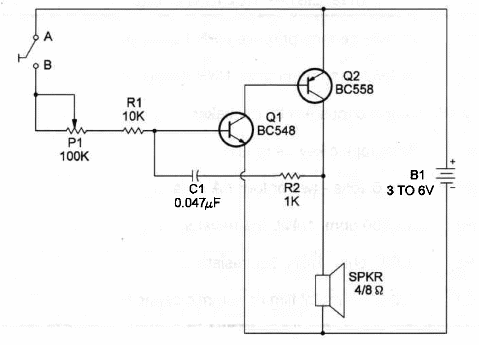
Q1 and Q2 form a directed-coupled amplifier and R1/C1 is the closed Ioop that takes the signal back from the output to the input.
Figure 2 shows the Iayout of the components, using a terminal strip as chassis.
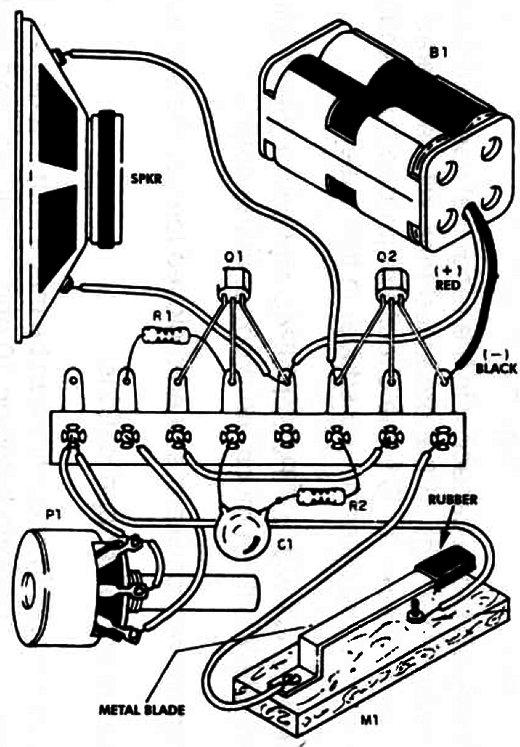
AII the components and power supp!y can be housed in a smaII plastic box.
The key is a telegraph homemade type switch, bUt you can also use an SPST toggle or slide switch for continuous operation.
A key is recommended if you want to use the oscillator as a Morse Code sender in demonstrations or practice.
You can wire the points A and B to the contacts of a relay to use the circuit as part of an alarm.
Audio Oscillator
Q1 - BCS48 general purpose NPN transistor
Q2 - BCSSB general purpose PNP transistor
SPKR - 4 or 8 ohm small loudspeaker
M1 - Telegraphic key - See text
B1 - 3 to 6 volts - twoor four AA cells
R1 - 10,000 ohm,1/4 W, 5% resistor
R2 - 1,000 ohm, ¼ W, 5% resistor
C1 t- 0.047 µF metal film or ceramic capacitor
Ideas to Explore
To Iearn more about the circuit or to get better peñormance:
0 Change C1 for a capacitor in the range between 0.01 and 0.22 µF. The frequency range of the produced tone willr be altered. With 0.01 µF or Iower values for C1, the circuit wiII produce ultrasounds. Use a tweeter or a piezoelectric transducey in this .case.
Reptlace Q1 with a TIP32 orTIP42 and power the circuit with a 12 volt supply. You'II get much more power in the output.
Explain why oscillators need a closed Ioop to the signal to work.
Science projects and other applications:
Experiments in acousticscan be made with this device. The circuit can produce any tone between 10 and 20,000 Hz, and even higher.
A telegraph station can be simulated with this circuit.You can find Morse Code in any book about telegraphy.
By replacing K with a reed swich wired to points A and B, the circuit wilI operate as an alarm. Experiments involvíng conductivity of materials can be made with probes plugged to points A and B.
Connect resistive transducers as LDRs and NTCs at points A and B to get a Iight-dependent or temperature-dependent oscillator.
Using two metal rods as sensors, the circuit can be use as a lie detector or bio-feedback device. Replace C1 with a 0.22 or 0.47 µF capacitor and adjust P1 to get separated pulses at the speaker. The pulse rate wiII be altered when the skin conductivity of the interrogated person changes while in a state of strain due to a lie or stress.
A 117 V – 6 V x 250 mA transformer can replace SPKR to produce high-voltage pulses in nerve stimulation experiments. The generated pulses can reach voltages as high as 400 Vpp.
Experiments in animal physiology can be conducted using sounds or high voltage as described in other projects. Growth of plants submitted to high-power sounds or high-voltage fields can be observed using this circuit with practical experiments.
AC fields can be generated by replacing the speaker with a 20-turn coiI. The plants or animals can be positioned within the coil's electric field. See the same experiment using the DC Dimmer (MIN012E) for coil and experiment details.
Note: This circuit is part of the author’s book Fun Projects for the Experimenter Vol1 – TAB Books – 1998


